
Kathryn Friedlander invites you to a conversation about how creative expertise develops. This open-access special issue of the Journal of Expertise pairs a précis of her book The Psychology of Creative Performance and Expertise with commentaries from leading researchers, followed by her response and reflections on where the field goes next.
If you have ever wondered why some people reach extraordinary levels of performance in music, dance, acting, writing, science, or other complex domains, you have probably encountered two familiar explanations.
One focuses on practice: the hours, the coaching, and the sustained effort. The other leans on aptitude: the early signs of talent, fast learning, and unusual potential. But the science has moved on. Over the last couple of decades, researchers have increasingly argued that neither “practice alone” nor “innate talent alone” can carry the full explanation. Instead, we need multifactorial accounts that examine how abilities, motivations, personality, environment, opportunity, and culture interact over time to shape exceptional performance.
All the same, expertise research often focuses on a small number of anchor areas – sport, chess and violin playing, for example – without considering the important drivers of creative fields such as the performing, tactile, and literary arts. Aesthetic appreciation, authentic expression and creative adaptation are surely key to these areas, yet absent from much of the core literature.
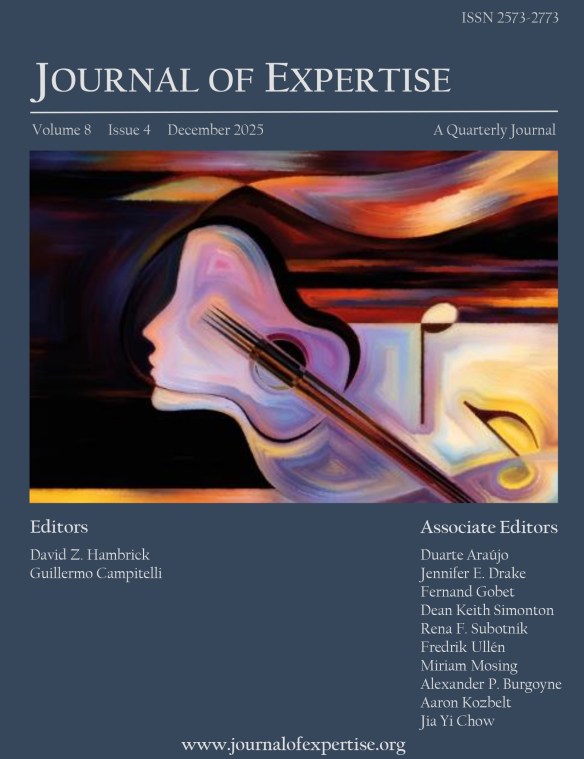
Against that backdrop, I’m delighted to share a new open-access special issue of the Journal of Expertise devoted to my book, The Psychology of Creative Performance and Expertise (Routledge, 2024). Every article in the issue is free to read online, and the issue is designed as a coherent scholarly conversation rather than a loose collection of papers.
What is this issue, and how is it structured?
The issue uses a format that some readers will recognise from “target article” debates: there is a ‘target’ piece (my précis of the book), followed by short commentaries from researchers, and then my final response that draws out points of convergence and disagreement. The result is an accessible way to see a field thinking aloud: what different scholars consider central, what they think needs revising, and where they see the most promising research horizons.
A quick introduction to the book (for newcomers)
When I first announced the book here on CreatePsy, I described it as a response to a gap I kept encountering in teaching. There was no single, accessible text that brought together research on expertise development while taking seriously the creative and performing arts.
The book is a textbook-style guide (aimed primarily at final-year undergraduate and postgraduate readers) that does three things:

- It lays out core theories and methods in expertise research, including the importance of being clear about what counts as “expert” performance, and how researchers benchmark levels of skill.
- It expands beyond the usual “anchor” domains (often chess, sport, and Western classical music) to include a wider range of creative performance fields, including dance, theatre and film, creative writing, and visual art, as well as other cognitive domains and STEM.
- It treats creativity and expertise as part of the same multifactorial framework, rather than as separate topics. In many creative domains, high achievement depends not only on efficient execution, but also on interpretation, reinvention, and innovation.
This last point is one of the threads running through the special issue: what changes when we stop treating “expertise” as synonymous with replication and reliability, and instead ask how expert performance can also be creative.
What do the commentaries add?
One of the most enjoyable things about this issue is that the commentaries do not converge on a single critique. Instead, they extend the conversation in different directions, from different starting points.
A few themes that recur across the issue include:
- How should we conceptualise creativity within expertise? Contributors explore how creativity shows up differently across domains, including highly structured ones, and what “creative” means when performance is constrained by rules, style, genre, or tradition.
- Metacognition and self-regulation. Another thread focuses on how expert creators monitor and steer their own thinking while producing work, including reflection, evaluation, and revision.
- Embodied and enacted expertise. Some commentators push for a stronger emphasis on the bodily, situated, and social nature of skilled performance, especially in the performing arts.
- Developmental trajectories and opportunity structures. A consistent theme is that “who becomes an expert” is shaped not only by individual differences, but also by access to training, mentoring, gatekeeping, and culturally influenced opportunity.
- The future of creative expertise. The issue also raises questions about how creative expertise might be reshaped by rapidly shifting social and technological conditions, including how AI tools may influence both learning and evaluation.
Taken together, the issue’s overall mood is not fragmentation but constructive convergence: an emphasis on integrated accounts that can handle creativity, individual differences, and context without collapsing into single-factor explanations.
Why this matters beyond academia
Even if you are not a researcher, there are practical reasons to care about how creative expertise develops.
We make decisions all the time about training, selection, talent identification, and evaluation in education, music, sport, science, and the arts.
We debate whether performance is “authentic” or “trained”, whether creativity is “inspiration” or “craft”, and whether new tools support learning or replace it. We also worry about why so many talented people burn out, stall, or never get the opportunities they need, despite deep commitment.
A multifactorial, psychologically-informed view of creative expertise helps us ask better questions about what excellence is, what it costs, and how it is supported. These questions matter not only in research, but in studios, classrooms, workplaces, and everyday life.
Image:
- Journal of Expertise front cover, Vol 8 Issue 4, Dec 2025
- Creative workspace: royalty-free at https://pixabay.com/photos/people-man-drawing-artist-notebook-2562024/
My thanks to Zach Hambrick and Guillermo Campitelli for convening the special issue, and to the commentators for their generous and rigorous engagement.
 CREATE Ψ
Pingback: Mental imagery as a hidden engine of creative expertise | CREATE Ψ